
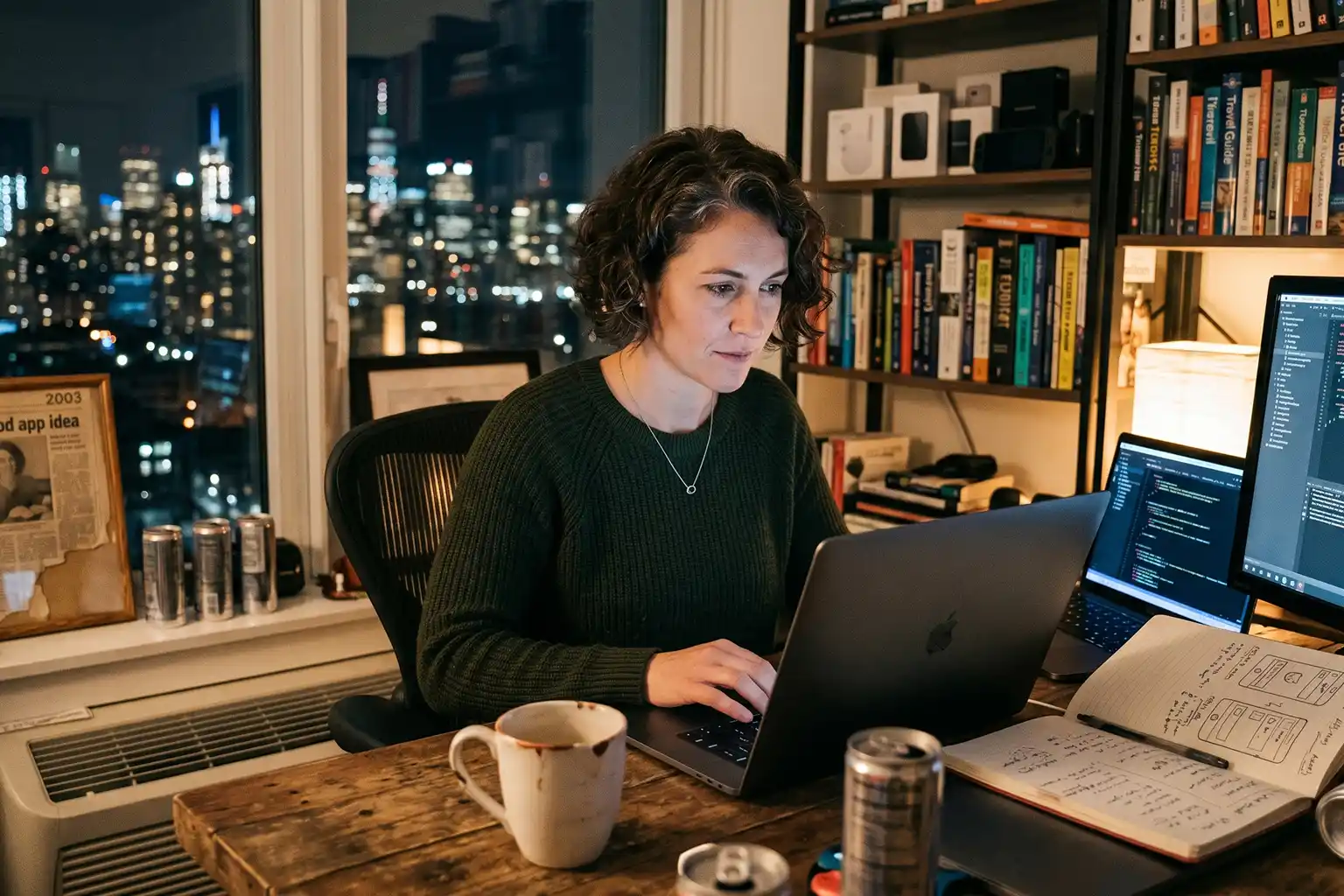
She Spent 15 Years Building an App That Started as a Spreadsheet in a D.C. Hotel Room
The idea for Healthy Anywhere came to Lee Balcomb at 1am in a corporate apartment in Philadelphia with nothing to eat.
She'd flown out of San Francisco at 6am, waited out a multi-hour tarmac delay, and finally arrived hours later to four walls and no food. That was January 2003. She told herself: never again. She was going to map her options before she traveled so she'd always know where to go.
That was the spark. Twenty-two years later, she's still building.
This conversation was recorded live at a Startups with Stu retreat in Laguna Beach, California — the kind of event host Chad Willard San puts on that has people meeting outside, on the beach, doing real business.
Growing Up Foggy in Montgomery
Lee didn't grow up thinking about food systems. She grew up in Montgomery, Alabama, eating out almost every night. Shoney's. Little Caesars with a two-liter Coke. Krispy Kreme crullers on Saturday mornings. By seventh grade she was trying SlimFast and protein bars, not to lose weight exactly, but just to feel better. She was bloated. Foggy. Not okay in a way she couldn't fully name.
It wasn't until her 20s, after she moved to California, that she had the experience of eating vegetables that came from the ground rather than a can. Extra virgin olive oil. Fewer chemicals. She had never felt better in her life. It sounds simple. It changed everything.
Then she got a consulting job that had her traveling every week, and she was determined to eat well on the road. She discovered, quickly, that airports at 6am don't make that easy. Soup, Mexican pastries, protein bars, frozen yogurt. No thanks. She'd wait for the layover. The layover would disappear. She'd land late in a city with nothing open.
Philadelphia at 1am was the line.
The 14-Column Spreadsheet Nobody Asked For
The first version of Healthy Anywhere wasn't an app. It was a spreadsheet she built on a Friday night when she found herself stuck in Washington, D.C. after a work trip.
She was there for the weekend. She sat down and went through food writers, top 100 lists, menus, Google searches, everything she could find. She built a list of 78 restaurants across 14 columns. Wild fish. Organic vegetables. Leafy greens (real ones, not just romaine and iceberg). Healthy fats and oils.
She had the best weekend of her life. Artisan espresso with organic milk. An all-organic green juice in a glass reusable jar. Brunch. Dinner. All of it mapped out and worth going to.
Before long, coworkers were asking her where to eat. She became the person you came to. That's usually how it starts.
When private equity bought the company she'd worked at for years and the culture caved, she finally decided she was done waiting. In 2018, she left. She was going to build this thing.
The Decompression Nobody Warns You About
She thought it would take $200,000 of savings and two years, and she'd have a million users.
Instead, she walked out of her job and felt the wall hit her. She needed months just to decompress. She hadn't realized how tired she was after eleven years of going hard. She sat with the walls for a while. Then she figured out she didn't know marketing. Or websites. Or really anything about building a product.
So she did what some founders do and most don't. She went through the courses. She read 60 books that year. She got a holistic nutrition certification. She studied sustainable food systems at UC Berkeley, going deep into the connection between how food is grown and how it affects the body. The lightbulbs, she says, were going off constantly. Food grown properly tends to be healthier and taste better because it's fresher. The scoring system she started building in 2019 came directly out of that immersion.
Sixty books in a year is not a casual statement. That's a person who decided to earn the thing.
The AI Contractor Who Quietly Wrecked the Pipeline
Not everything worked.
She brought on an AI contractor to help automate the curation process. They worked together for a stretch. Then, well down the road, she discovered how bad the output actually was. Everything had to be manually redone. The damage wasn't visible until it was a double whammy. Time lost. Work lost. Trust in the automation approach, at least for that period, lost.
She talks about this the way founders who've been through real setbacks do: as a lesson she's integrated, not an identity she's carrying. The app is over 600 locations worldwide now. The scoring is entirely manual. That's intentional. Everything goes through the same evaluation system, the same thresholds, the same standards. If Alice Waters recommended a restaurant, Lee would still put it through the scoring system.
That's not perfectionism. That's the product.
Colorado Springs, 30 Restaurants, and a Developer Who Disappeared
In 2025 Lee had the realization that she could spend every day of the rest of her life building and end up with a few hundred users. She needed a different approach.
She'd always wanted to do something like Restaurant Week, but healthy-anywhere style. A citywide event, app-powered, built around community. An excuse to wrap her best customers up in something real and give them a reason to get excited.
She picked Colorado Springs. She had never been. She knew exactly one person there, a woman named Sandy Griffin who was organizing a local health and fitness expo. Sandy told her to go for it. Less than 12 weeks later, Lee had 30 restaurants signed up, more than $2,000 in prizes, and a new app build in development that was going to make the whole thing sing.
Four days before the launch party, the developer went dark.
She didn't cancel. She didn't postpone. She figured out a QR/PHP workaround herself and coded it until two hours before the party started. It wasn't elegant. It wasn't what it was supposed to be. But it worked.
She went on live TV twice. She got 60 to 70 email addresses from people who came through. Four restaurants out of the thirty drove 72% of the QR scans. Current app members drove down from Denver, Boulder, and Fort Collins. One woman brought her husband for the whole week, went to five restaurants, came to Lee at the end and said, "Who do you need? Because if you can do all of this by yourself, imagine what you could do with support."
She didn't hit the subscriber numbers she'd hoped for. She's honest about that. But the connections she made, the podcasts she'll record with a leader in international hospitality, the celebrity chef she met through it, the people who showed up like they were arriving to something important, that stuff is harder to quantify and easier to dismiss if you're only looking at conversion rates.
The lesson she pulled from it: don't run a citywide event until you have 200 super-users in that city first. Then you're building a party for people who already care, not hoping strangers convert.
Why She Won't Raise Money Yet
Lee is bootstrapping. No investors. She said it almost like a dare when Stu asked her about it.
She's been at it since 2018. She doesn't have a sustainable business yet in the traditional sense. She knows she'll probably need capital at some point. But she won't go after it now because she doesn't feel like she's earned it.
That's a rare thing to hear. Most founders treat fundraising like a milestone to unlock, a sign that the work is real. Lee treats it the opposite way. She wants to prove the thing can move on its own before she asks anyone else to believe in it. There's something almost stubborn about it. Also something honest. She's not willing to paper over the traction problem with someone else's money.
She described the product itself with total clarity: very highly curated, very specific standards, designed for people who are busy, health-conscious, traveling, and unwilling to let a hectic schedule get between them and eating well. The app has a gut-friendly filter. A "best brunch" award. It surfaces regenerative farms, house-fermented foods, anti-inflammatory menus. When she showed a San Antonio restaurant called Farm Table, it had hit almost every threshold in the system. She called it almost a clean sweep.
The product is real. The market is real. The match between them is still being solved.
What Stuck With Me
Lee mentioned an 84-year-old angel investor who told her to stop stressing. To look at everything she'd built, everything she'd learned, and understand that this was already a phenomenal success regardless of what happens next. She reflected on that conversation, she said, a lot.
And then she said the thing that landed: "It's not what I'm building. Ultimately, it's who I am becoming."
Most founders don't say that. Most founders are so deep in the metrics and the milestones that the person doing the building barely comes up in conversation. Lee said it naturally, without fanfare, the way you say something you've actually had to work to believe.
She's been carrying this idea since 2003. She's been building it full-time for eight years. She coded her own launch solution two hours before the party started when the professional she hired didn't show up. And she's not done, not close to done, not even pretending to be close.
There's no grand theory here. Just someone who cares enough about a problem that she keeps showing up for it. That's either the definition of a founder or the definition of something deeper. Maybe both.
Related blogs


Subscribe for Updates
Subscribe to the Startups With Stu newsletter and get advice and stories sent straight to your inbox to help launch your business to the moon!
Comments