
He Started a Wing Delivery Business in His Frat House Kitchen. Every Bank Said No. His Parents Didn't.
The kitchen closed at 6:30pm every night.
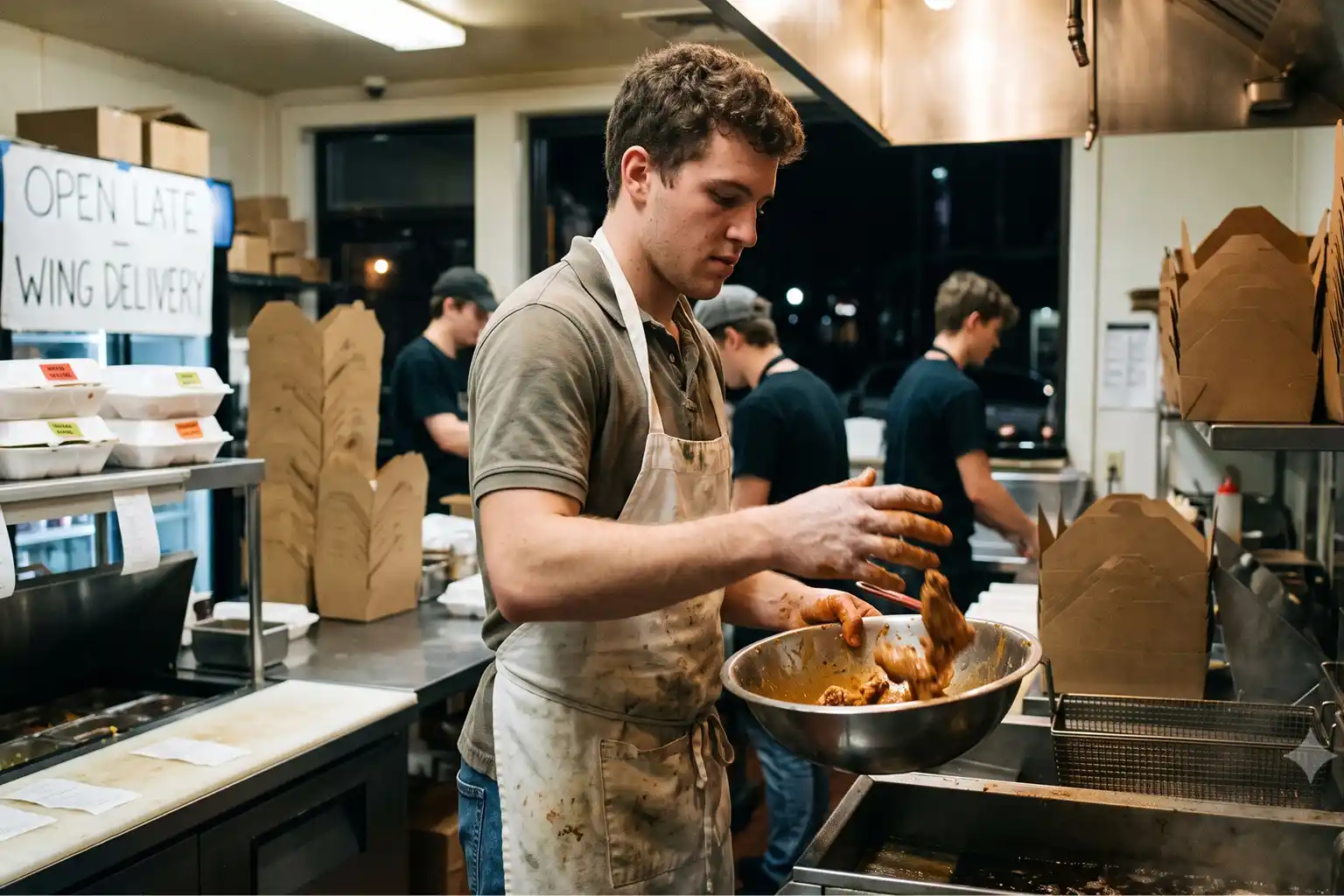
Matt Friedman was a college student at the University of Florida in 1993, living in a fraternity house with a full commercial kitchen that sat empty from dinnertime until the next morning. He looked at that kitchen and thought: delivery. Late night. Wings.
He'd been studying Domino's Pizza. Not eating it — studying it. The whole premise was delivery to a campus in Michigan, built from almost nothing, turned into a national brand. Matt figured the same logic applied to wings. College students didn't eat breakfast. Their lunch was breakfast. Their dinner was lunch. And their third meal of the day happened after 10pm, when almost nothing was open and almost nothing delivered.
He went to the fraternity president — a good friend — and asked if he could use the kitchen to test an idea. Then he had a phone line installed, made some fliers, drove to Sam's Club for wings, fries, sauces, and one type of Coke. Not Diet Coke. Not Sprite. Just one type of can.
Total investment: $500.
The demand showed up fast. People saw a flier that said wings, late night, free delivery, and the reaction wasn't skepticism. It was: I'm in. Guerrilla marketing on a college campus in 1993 — no social media, no algorithms, just boots on the ground and door hangers — and within four months he had enough proof to know the model worked.
Then he walked into twelve banks and got told no by every one of them.
The $50,000 Parental Loan (And the Graduation Clause)
No credit history. No net worth. No assets. A one-page concept document, some basic financials, and a four-month test run out of a fraternity kitchen. That's what Matt brought to a dozen banks in 1994.
None of them said yes.
He's said in interviews since that he's glad they didn't. The experience taught him something that most founders learn the hard way: traditional lending isn't built for someone with a good idea and no track record. Friends, family, angels — that's the pool for early-stage founders who need someone to bet on them personally, not on a spreadsheet.
For Matt, that was his parents. Middle class family. Not wealthy. And they said yes to $50,000 — which in 1994 was a real sum of money to put on the line for a kid who wanted to deliver wings.
Two conditions. First: it was a loan, not a gift. It would be paid back whether the business succeeded or failed. Second: he had to graduate first. He did. And the first Wing Zone storefront opened near the University of Florida campus in 1994.
He found the location by looking for failure. There was a small restaurant that had closed down close to campus. The hood exhaust system was already in. The bathrooms, electrical, plumbing — all there. He put in equipment, slapped a sign on the building, made some repairs. Lipstick on a pig, he calls it. It was enough.
The Partner Who Made It Possible
Adam was a fraternity brother. Then Matt's first manager. Then, eventually, a 50/50 partner in Wing Zone for the entire 27-year run of the business.
They are still best friends. In 27 years they had fewer than five real arguments.
Matt says the reason is simple: they didn't do the same things. Adam was meticulous with numbers, great at technology, wired for documentation and systems. Matt was the visionary, the salesman, the one who could walk into a new city and figure out how to make a restaurant work. Sales and marketing on one side; finance and operations on the other. No overlap, no friction, no competition for the same lane.
Most co-founder breakdowns happen because two people who are too similar end up stepping on each other. Matt and Adam found a partnership that worked because they each had exactly what the other didn't. Twenty-seven years is evidence enough that it was the right call.
Inc. 500, Seven Stores, and the Domino's of Wings
The model was clear from the beginning: college towns. Late night. Delivery. Same thing Domino's had proven, but wings instead of pizza.
He expanded by pulling his best manager from each location and taking that person with him to open the next one. Move to a new city, set up the operation, stay for about six months, then hand it off and move again. He describes the decade between starting and franchising as traveling like a lunatic.
Seven company-owned stores across Florida and Georgia, all near major college campuses. Enough volume and enough systems that when customers started coming in and asking if Wing Zone was a franchise, Matt started hearing it as a signal instead of just a compliment.
They made the Inc. 500. Bootstrapped. No outside investors. Just a $500 start and two guys who knew what the other was good at.
Franchising Isn't the Restaurant Business
In 2001, Wing Zone started franchising. And Matt learned immediately that he had started an entirely different company.
Running restaurants and running a franchise system require completely different skills, different teams, different metrics, and different mindsets. He and Adam made the decision to split the two operations: separate companies, separate staffs, same 50/50 ownership of each. Adam ran the restaurant chain. Matt ran the franchise company.
It was the right call. But it still didn't make the franchise side easy.
Two and a half years. That's how long it took before the franchise company showed a dollar of profit. Forward investing the whole time, building the system, signing franchisees, supporting their openings, developing training and supply chain — all of it funded by revenue from the restaurant side. Most people who get excited about franchising their concept don't understand that math. They think the royalties start rolling in immediately. They don't.
His first franchisees were his own store managers. People who had worked inside the system, understood it, believed in it, and wanted a piece of it. That's the smart play: your best internal operators already know the product works. They're not taking a leap of faith. They're taking a calculated next step.
Franchising did eventually become the recurring revenue machine it's supposed to be. But the path was longer and harder than anyone tells you it will be.
The Rhino and the Thick Skin
Matt's mascot for himself is a rhino. Thick skin.
Being a franchisor, he explains, means accepting something psychologically uncomfortable: when your franchisees succeed, they take the credit. When they struggle, they point at you. You are simultaneously the brand they signed up for and the system they blame when it doesn't work.
That dynamic never goes away. You have to go in knowing it, accept it, and build the skin for it. The reward isn't gratitude. The reward is watching someone build a business that wouldn't have existed without what you created — and occasionally, when a franchisee really breaks through, getting a glimpse of the impact.
He sold Wing Zone in 2021. Twenty-seven years from frat house to exit.
Epic Wings and the Case for Staying Regional
His current company is Epic Wings. Forty years old. Thirty-five locations. All Southern California. No freezers in any restaurant — fresh cut fries, fresh bread, fresh everything. They do famous breadsticks alongside the wings.
He took the CEO role because the brand had something he respected: discipline about what it was and where it operated. No national ambitions. No franchise expansion to chase a bigger number. Just a powerhouse in its region, built on consistency, that had survived four decades because it knew exactly who it was.
That last part is the thing Matt keeps coming back to — in restaurant businesses, in franchise systems, in any consumer-facing operation. Consistency beats quality. Not because quality doesn't matter, but because customers don't return to the best restaurant they've ever been to. They return to the one that's the same every time. The place that never disappoints even if it never astonishes.
He admits Wing Zone struggled with this. Some nights they were transcendent. Some nights they weren't. Epic Wings, in his view, doesn't have that problem. And that's why he's there.
What Stuck With Me
Matt Friedman spent 27 years in the same business. That's not a pivot story. It's not a serial entrepreneur story where you get bored and move on to the next thing every few years. He stayed in the game, through the hard parts and the plateau parts, long enough to see what persistence actually produces.
The frat house kitchen and the Sam's Club run are fun origin details. But the real story is in the decade of traveling like a lunatic to open stores, the two and a half years of franchise losses, the partner he never fought with because they understood each other well enough to stay in their lanes.
Most entrepreneurs want the exit before they've earned it. Matt built something that took 27 years to exit because it took 27 years to be worth what it was worth. That's not a failure of ambition. That's what it actually looks like when you build something real.
Recorded live at a Startups with Stu retreat. More at startupswithstu.com.
Related blogs


Subscribe for Updates
Subscribe to the Startups With Stu newsletter and get advice and stories sent straight to your inbox to help launch your business to the moon!
Comments