
He Walked Into a Dirty Airport Bathroom in 2015. He's Still Fixing It.
Rob Polecki had a patent, a prototype, and a toilet seat he needed to wheel through the Venetian Hotel in Las Vegas. He sat in his car for ten minutes before he could make himself do it.
He did it. And it changed everything.
This conversation happened at a Startups with Stu retreat, and Rob's story is the kind that doesn't fit neatly into a highlight reel. No overnight exit. No VC-fueled rocket ship. Just an Idaho politician who noticed something broken in a public bathroom in 2015, wrote it down in his iPhone notes, and then spent the next decade doing everything he'd never done before — filing patents, pitching Shark Tank, negotiating with Fortune 500 companies, cashing out his government retirement fund, and knocking on doors one toilet seat at a time.
Here's what that actually looks like.
The Airport Bathroom That Started It All
He was with his four-year-old son at the old Salt Lake City airport. His son did the potty dance. They waited in line. They got into the stall and found a dirty seat.
Rob tried paper covers. His son kicked them off. He ran to the sink for paper towels and soap. And standing there in that bathroom, he looked around and noticed: everything in this room is hands-free. The faucet. The soap. The dryer. Everything except the one surface you actually have to sit on.
"Why isn't there something better than paper seat covers?" he asked himself. After a little research, the answer was pretty clear: because nobody had built it yet.
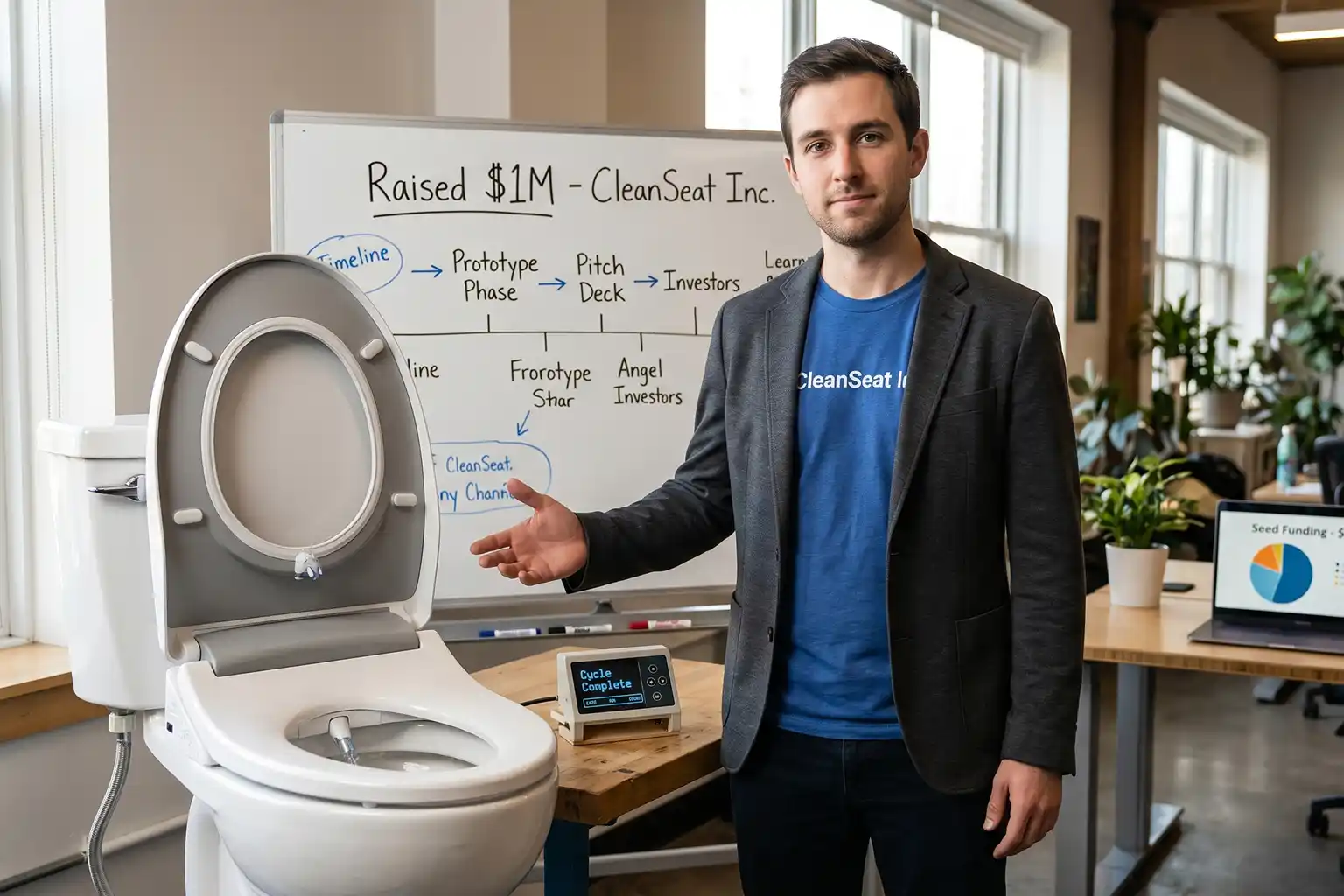
That's the gap he's been filling ever since. Washi — pronounced like the Japanese paper — is a self-sanitizing commercial toilet seat. Battery-operated. No water hookup required. Soap cartridge built in. It sprays the seat. It cleans the bowl when you flush. And it's been fighting for shelf space in airports, convention centers, gas stations, and Delta Sky Clubs for the better part of four years.
Quitting Politics, Carrying a Toilet Through a Hotel
Rob was an elected official in Idaho. Two terms in. And somewhere in that second term, he looked around and decided politics wasn't going to be the whole story.
"I'm an idea guy," he told Stu. He keeps a running list in his iPhone notes. The toilet seat idea had been sitting there since 2015. He didn't act on it for three years.
When he finally moved, he moved fast. He applied for a patent. Then he applied for Shark Tank. And then he found himself in the parking lot of the Venetian Hotel in Las Vegas — Shark Tank auditions running alongside CES — with a full toilet seat on a cart, trying to talk himself into wheeling it through a luxury hotel lobby.
He sat in his car for ten minutes. Then he pushed it in.
The producers loved the concept. He made it to the final round. Then he got cut.
Most people would lead with the cut. Rob leads with what it gave him. "I was always a part-time entrepreneur," he said. "I depended on the 9-to-5 paycheck, the insurance, the safety." Shark Tank didn't hand him a deal. It handed him the courage to go all-in. Same product. Higher stakes. No parachute.
The Georgia Pacific Year
Before Rob started making sales, he tried to skip that part entirely. Licensing felt like the smart move. Let someone bigger take the product to market. Collect royalties. Done.
Georgia Pacific — the largest restroom company in the country, based in Atlanta — came knocking. They tested the product. They ran engineering data reports. Discussions stretched out for over a year. Rob stopped making sales calls. Stopped developing international prototypes. Just waited on the deal.
Then their leadership told him: go launch it yourself, and we'll buy it later.
"They wasted a year of my life," he said plainly. No drama. Just the math.
He pivoted to proving it himself. Which meant learning everything he didn't know — CRM software, email campaigns, pitch decks, B2B sales cycles, investor pitches, distribution strategy. None of this was in the Idaho government playbook.
The 401K, the Angels, and Blake Hanson
When Rob quit politics and went full-time, he cashed out his government 401K. Over $100,000. Gone.
Then he went looking for more. Friends and family in Pocatello, Idaho — $500,000. Then he moved to Utah to be closer to the Salt Lake City airport and started pitching VCs. No luck there. Angels, though, kept writing checks. Fifty thousand here. Two hundred thousand there. Pitch after pitch, one by one, until he crossed $1 million raised.
And then he got lucky. Blake Hanson, out of Boise, came in as a lead partner and has helped fund the company through some of its toughest stretches.
"I don't know what I did to deserve it," Rob said. He keeps coming back to that. Every time he talks about his investors, there's something almost devotional about it. He's not treating their money like capital. He's treating it like trust. "I'm never going to give up," he said. "Other people's money is what's keeping this thing going, and I have to give back."
That's not the kind of thing most founders say out loud. Most founders talk about exits. Rob talks about responsibility.
Nine Months for a Wyoming Airport
Here's what B2B actually looks like for Washi.
They're in Delta Sky Clubs. Big gas station chains in the Midwest. Convention centers in the South. Those wins are real. But getting there required the kind of patience that would make most people reconsider their life choices.
Some of those airport deals took nine months from the first meeting to a signed contract. Nine months of budget cycles, facilities priorities, renovation schedules, procurement committees. Nobody's thinking about toilet seats when they're building out a new terminal. You get in line and wait.
Rob tried solving this with a direct sales team. It didn't work fast enough. Last year he fired his internal sales reps and moved to distributors — the big janitorial companies that already have relationships with the facilities managers who actually make these decisions. It took him two years to figure out what should have been obvious: stop knocking on doors nobody knows you, and go through the people who already have the keys.
One of the harder lessons of early-stage hardware. The product wasn't the problem. The route to market was.
James Dyson and the Entrepreneurial Curse
There were days Rob almost quit. He's honest about that.
What kept him going was other people's stories. He listens to Guy Raz. He's heard almost every episode of How I Built This. Reed Hoffman's Masters of Scale. And his favorite? James Dyson — the vacuum guy who mortgaged his house, built 5,000+ prototypes, and didn't break through for over 15 years.
"If he went through it," Rob said, "I've got to just keep going."
There's something Stu called "the entrepreneurial curse" in this conversation, and it's real: the inability to see a way out other than forward. Rob doesn't have a Plan B. He's mentioned it twice now. That's not bravado. It's more like a coping strategy. If there's no exit ramp, you stop looking for one.
What Rob has figured out — and it matters — is the difference between the dip that has an upside and the dip that doesn't. Stu brought up Seth Godin's book on this subject, and Rob knew exactly what he was describing. You have to keep asking yourself: can I see the path to the other side? If the answer is yes, the only move is forward.
For Rob, it always comes back to five-star reviews and industry professionals who look at the product and say: why hasn't anyone done this before?
That's not nothing. That's the whole case.
Going Home
The B2B path is slow. Rob knows it. And so this year, Washi is going consumer.
The home version of the seat is launching on Kickstarter in May 2026. It's a different product than the commercial version — sleeker, designed for residential bathrooms, aimed at the mom with kids who want a clean toilet without the guesswork. Soap dispenses on the seat. Sprays the bowl on every flush. Deodorizes.
Go to washihome.com. You'll see it.
The B2C path is faster. Seven touchpoints instead of nine months. Volume instead of account size. Social media as a real tool, not a tightrope walk between premium brand positioning and toilet humor. Rob has been carefully threading that needle in B2B for years — Delta Sky Clubs want elegance, not potty jokes. But in the home market, you can talk to parents the way parents actually talk.
This feels like the unlock.
What Stuck With Me
The thing about Rob Polecki isn't the product. Plenty of people have built clever hardware. The thing about Rob is the way he carries other people's expectations without being crushed by them.
His wife moved. His kids changed schools. His daughter got bullied. His investors wrote checks on faith. His family went along for the ride on something that has no guaranteed ending. And he still shows up on LinkedIn every day, posting with what Stu called "can't stop, won't stop" energy, talking about the journey without pretending it's been easy.
He made up a quote somewhere along the way. He keeps it with him: this door opens the next.
That's it. That's the whole philosophy. Not disruption. Not scale. Not exit multiples. Just: get through this one so you can open the next one.
Eleven years in. Still going.
Recorded live at a Startups with Stu retreat. More at startupswithstu.com.
Related blogs



Subscribe for Updates
Subscribe to the Startups With Stu newsletter and get advice and stories sent straight to your inbox to help launch your business to the moon!
Comments